
A fracture can make even simple movements difficult. When a bone breaks, the main goal of treatment is to restore its alignment, provide stability, and allow the bone to heal properly. For certain long-bone fractures, Interlocking Nail Fixation can be an effective surgical option.
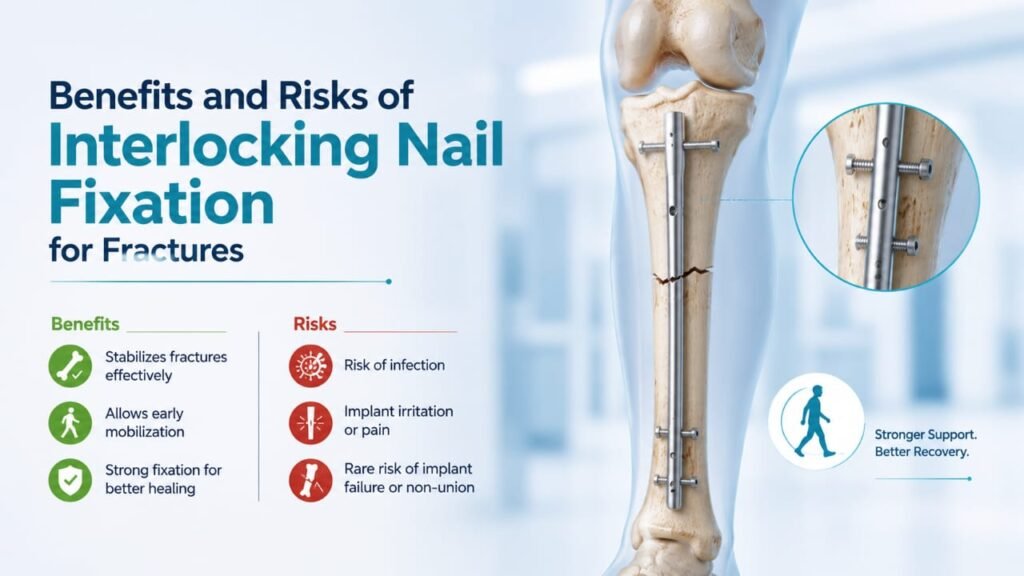
This technique uses a metal nail placed inside the hollow center of the bone. Locking screws are then used at one or both ends of the nail to help keep the broken bone stable while it heals.
Like any surgical treatment, Interlocking Nail Fixation has both advantages and possible risks. Understanding these can help patients have a better conversation with their orthopedic surgeon before making a treatment decision.
What Is Interlocking Nail Fixation?
Interlocking Nail Fixation is a type of internal fixation commonly used for fractures of long bones such as the femur and tibia, and in selected cases other bones.
During the procedure, the surgeon carefully aligns the broken bone and places a specially designed metal nail inside the bone’s medullary canal. Locking screws are inserted through the bone and nail to prevent unwanted movement.
The purpose is to maintain stability and alignment while allowing the bone to heal.
The exact surgical approach depends on the location and pattern of the fracture, the patient’s overall health, and the bone involved.
How Does Interlocking Nail Fixation Work?
The procedure is generally performed under anesthesia.
After the bone fragments are aligned, the surgeon introduces the nail into the bone. Locking screws help control rotation and maintain the length and alignment of the bone.
Once the fixation is stable, the surgical wounds are closed and the patient is monitored during recovery.
Depending on the fracture and the surgeon’s assessment, controlled movement or weight-bearing may be started at an appropriate stage.
The rehabilitation plan is individualized and may include physiotherapy to restore strength, flexibility, and function.
Key Benefits of Interlocking Nail Fixation
One of the major advantages of Interlocking Nail Fixation is the strong internal stability it can provide for suitable fractures.
Provides Stable Fracture Fixation
The nail and locking screws work together to stabilize the broken bone. This can help maintain alignment while the fracture heals.
Supports Early Movement
Because the fixation can provide good stability, selected patients may be able to begin controlled movement and rehabilitation relatively early.
Early, appropriate movement can help reduce stiffness and support the recovery of surrounding muscles.
Useful for Long-Bone Fractures
Interlocking nails are commonly used for certain fractures involving the femur and tibia and may be suitable for particular fracture patterns.
The decision depends on the exact location, type, and severity of the fracture.
Strong Load-Sharing Fixation
Unlike some fixation methods that rely mainly on plates placed on the outer surface of the bone, an intramedullary nail sits within the bone.
This provides a load-sharing form of fixation, which can be useful in appropriately selected long-bone fractures.
Smaller Incisions in Many Cases
Compared with some traditional open fixation techniques, nail insertion may require relatively smaller surgical incisions.
However, the size and number of incisions depend on the fracture and the surgical technique used.
What Are the Risks?
Although Interlocking Nail Fixation is widely used, it is still a surgical procedure and can have potential complications.
Infection
As with any surgery, there is a risk of infection. Most infections are manageable when identified early, but deeper infections can sometimes require additional treatment.
Pain Around the Implant
Some patients may experience pain or irritation around the area where the nail or locking screws were placed.
Persistent pain should be evaluated by the orthopedic surgeon to determine its cause.
Delayed Bone Healing
Some fractures take longer than expected to heal. Factors such as the fracture pattern, blood supply, smoking, diabetes, nutrition, and other health conditions can influence bone healing.
In some cases, additional treatment may be required.
Nonunion
Occasionally, a fracture may fail to heal properly. This is called nonunion.
If this occurs, the surgeon may recommend further evaluation and, depending on the cause, additional procedures or other treatments.
Malalignment
If the fractured bone does not maintain the desired alignment during healing, a deformity or functional problem may develop.
Accurate surgical technique and appropriate follow-up help reduce this risk.
Nerve or Blood Vessel Injury
Although uncommon, nearby nerves or blood vessels can potentially be injured during surgery.
The risk varies depending on the location of the fracture and the surgical approach.
Who May Be a Candidate?
Interlocking Nail Fixation may be considered for certain shaft and selected other fractures of long bones, particularly when strong internal stabilization is needed.
However, it is not the best treatment for every fracture.
Your orthopedic surgeon will consider factors such as:
- Location of the fracture
- Fracture pattern
- Bone quality
- Soft-tissue condition
- Age and general health
- Presence of other injuries
- Whether the fracture is open or closed
- Expected rehabilitation needs
A detailed examination and appropriate imaging are important before selecting the fixation method.
Recovery After Interlocking Nail Fixation
Recovery varies depending on the bone involved, fracture severity, overall health, and whether there are other injuries.
After surgery, your doctor may recommend pain management, wound care, physiotherapy, and a specific weight-bearing plan.
Some patients may be allowed to put weight on the affected limb relatively early, while others may need to avoid or limit weight-bearing until there is sufficient healing.
Regular follow-up appointments and X-rays help the surgeon monitor the progress of bone healing.
Physiotherapy and Rehabilitation
Surgery stabilizes the fracture, but rehabilitation plays an important role in restoring function.
Physiotherapy may focus on:
- Improving joint movement
- Building muscle strength
- Reducing stiffness
- Improving balance
- Gradually restoring walking ability
- Returning to normal daily activities
The exercises should be performed according to the stage of healing recommended by your orthopedic team.
Do not increase weight-bearing or exercise intensity on your own, even if the pain has improved.
When Should You Contact Your Doctor?
After Interlocking Nail Fixation, contact your healthcare provider if you notice:
- Increasing pain or swelling
- Fever or chills
- Redness or discharge from the wound
- New numbness or weakness
- Significant difficulty moving the limb
- Sudden calf swelling or pain
- Shortness of breath or chest pain
Prompt medical evaluation can help identify complications early.
Final Thoughts
Interlocking Nail Fixation can provide strong and stable fixation for appropriately selected fractures, particularly many long-bone fractures. It can support alignment, allow controlled rehabilitation, and help patients gradually return to normal movement.
However, no surgical procedure is completely free of risk. Infection, delayed healing, nonunion, implant-related discomfort, and other complications can occur.
The best treatment depends on the type of fracture, bone involved, overall health, and individual recovery goals.
If you have suffered a fracture, an orthopedic specialist can assess your X-rays and clinical condition and explain whether Interlocking Nail Fixation or another treatment option is most appropriate for you.
The right fracture treatment is not just about fixing the bone—it is about helping you return to safe, functional movement.