Children are naturally active, which also means falls, sports injuries, and accidents can sometimes result in broken bones. While many childhood fractures can heal with a cast or splint, some long-bone fractures need additional stabilization to keep the bone properly aligned during healing.
Elastic Nail Fixation is a commonly used minimally invasive surgical technique for treating selected long-bone fractures in children. It is designed to provide stability while allowing the growing bone and surrounding tissues to continue developing.
The decision to use this technique depends on the child’s age, size, fracture location, fracture pattern, and overall health.
What Is Elastic Nail Fixation?
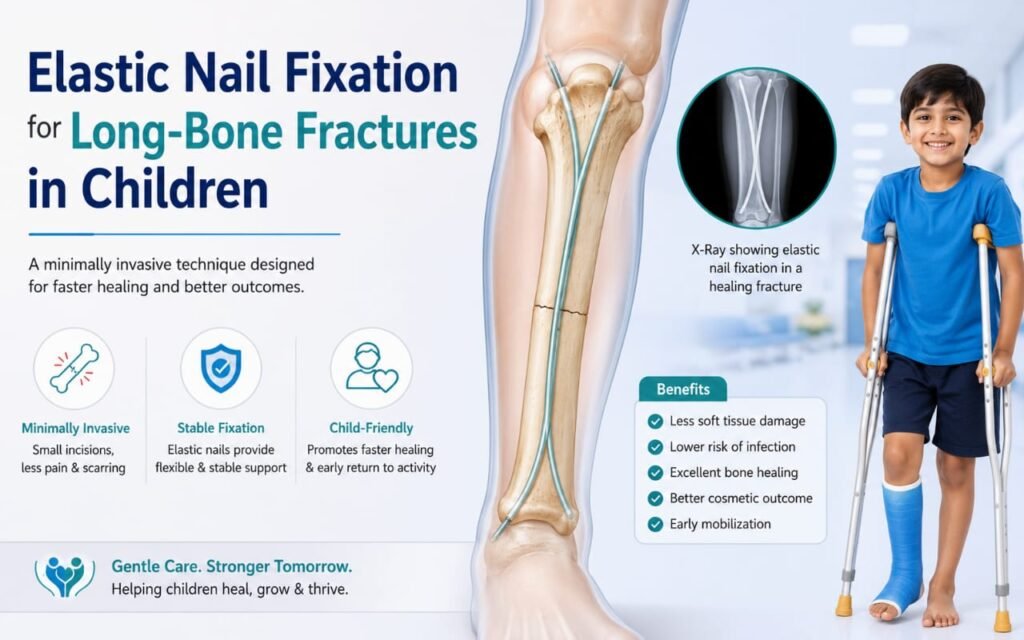
Elastic Nail Fixation uses flexible metal nails, often called elastic or flexible intramedullary nails, to stabilize a fractured bone.
The nails are inserted into the hollow central canal of the bone through small openings near the end of the bone. Once positioned, they provide internal support and help maintain alignment while the fracture heals.
Unlike some traditional fixation methods, this technique usually does not require a large incision directly over the fracture.
It is commonly considered for certain fractures of long bones such as the femur, tibia, and forearm bones in appropriately selected children.
Why Are Children’s Fractures Different?
Children’s bones are still growing and generally have a strong ability to heal and remodel.
However, some fractures can become unstable or significantly displaced, making it difficult to maintain proper alignment with a cast alone.
Elastic Nail Fixation may be considered when a fracture is unstable, significantly displaced, or difficult to control with non-surgical treatment.
The child’s growth plates are also carefully considered when planning treatment.
When Is Elastic Nail Fixation Recommended?
Not every fracture requires surgery. Doctors usually consider several factors before recommending fixation.
Elastic Nail Fixation may be appropriate for selected children with:
- Unstable long-bone fractures
- Significantly displaced fractures
- Certain femur fractures
- Selected tibia fractures
- Some forearm fractures
- Multiple injuries
- Fractures that cannot be adequately maintained in a cast
The final decision depends on the location and pattern of the fracture, the child’s age and size, and the surgeon’s assessment.
How Does the Procedure Work?
The procedure is usually performed under anesthesia.
The surgeon makes small openings near the end of the affected bone and carefully introduces the flexible nails into the bone’s central canal.
The nails are positioned so that their flexibility provides balanced support from within the bone while helping maintain alignment.
Once the fracture is appropriately stabilized, the small surgical wounds are closed and the limb is protected as needed.
Because the fracture site itself may not need to be widely exposed, the technique can reduce disruption to the surrounding soft tissues.
Benefits of Elastic Nail Fixation
One of the main advantages of Elastic Nail Fixation is that it provides internal stabilization through a relatively minimally invasive approach.
Smaller Incisions
The nails are inserted through small openings rather than requiring a large incision over the fracture site in many cases.
Supports Bone Alignment
The flexible nails help maintain the position of the fractured bone while it heals.
Encourages Early Movement
Because the fracture receives internal support, children may be able to begin appropriate movement earlier than with some forms of treatment, depending on the injury.
Minimizes Soft-Tissue Disruption
The technique generally avoids extensive exposure of the fracture site, which can help preserve surrounding tissues.
Suitable for Growing Children
When appropriately planned, the technique can provide stabilization while taking the child’s developing skeleton into consideration.
What Happens After Surgery?
After Elastic Nail Fixation, the child will be monitored in the recovery area and the affected limb may be protected with a dressing, splint, or cast depending on the fracture.
Some pain and swelling are expected during the early recovery period. Your doctor may prescribe appropriate pain relief and provide instructions for caring for the surgical area.
Weight-bearing or use of the injured limb will depend on the bone involved, fracture stability, and stage of healing.
Parents should follow the surgeon’s instructions carefully rather than encouraging the child to return to normal activity too quickly.
Recovery and Physiotherapy
Children often recover well from fractures, but the recovery period still needs appropriate supervision.
Physiotherapy may be recommended when necessary to restore movement, strength, balance, and normal use of the affected limb.
As the bone heals, the child can gradually return to school, play, sports, and other activities based on medical advice.
Regular follow-up appointments and X-rays help the orthopedic team monitor healing and confirm that the bone remains properly aligned.
When Are the Nails Removed?
In many cases, the flexible nails are temporary and may be removed after the fracture has healed sufficiently.
The timing depends on the child’s age, fracture location, healing progress, and the type of nail used.
Nail removal is usually planned only after the surgeon confirms adequate healing. The procedure may be relatively straightforward, but the decision is individualized for every child.
Possible Risks and Complications
Elastic Nail Fixation is generally considered a useful technique for appropriately selected pediatric fractures, but like any surgery, it has potential risks.
Possible complications include:
- Infection
- Pain or irritation around the nail ends
- Skin irritation
- Temporary stiffness
- Loss of alignment
- Delayed healing
- Refracture in some situations
- Rare nerve or blood-vessel injury
Your pediatric orthopedic surgeon will discuss the expected benefits and risks based on your child’s specific fracture.
Helping Your Child Recover Safely
Parents play an important role during recovery.
After Elastic Nail Fixation, make sure your child follows the recommended activity restrictions and attends every follow-up appointment.
Encourage a balanced diet, adequate rest, prescribed exercises, and safe physical activity as advised by the healthcare team.
Children often feel better before the bone is completely healed, so they may want to return to running or sports quickly. Avoid allowing high-impact activities until the doctor confirms that the bone is ready.
When Should Parents Contact the Doctor?
Seek medical advice if your child develops:
- Increasing pain or swelling
- Fever or chills
- Redness or discharge around the surgical site
- Numbness or unusual tingling
- Fingers or toes becoming unusually pale, blue, or cold
- Increasing difficulty moving the affected limb
- A new injury or sudden worsening of symptoms
Early evaluation can help identify and manage complications promptly.
Final Thoughts
Elastic Nail Fixation can be an effective treatment option for selected long-bone fractures in children. By providing internal support through a minimally invasive approach, it can help maintain bone alignment while allowing the child to gradually return to normal movement.
The best treatment is not the same for every child. Age, bone involved, fracture pattern, growth considerations, and overall health all influence the treatment decision.
If your child has suffered a long-bone fracture, a pediatric orthopedic specialist can assess the injury and explain whether Elastic Nail Fixation, casting, or another treatment option is most appropriate.
The goal is simple: help the bone heal properly while helping the child get back to being a child.