
IUI, or Intrauterine Insemination, is a commonly used fertility treatment that can help couples who are having difficulty conceiving. During IUI, specially prepared sperm are placed directly into the uterus around the time of ovulation, giving the sperm a better opportunity to reach the egg.
Understanding the IUI Success Rate can help couples have realistic expectations and make informed decisions about their fertility treatment. However, success is influenced by several factors, and the chances can vary from person to person.
What Is IUI?
IUI is a relatively simple fertility procedure. Around the time of ovulation, a semen sample is prepared in the laboratory to concentrate healthy, actively moving sperm.
The prepared sperm are then gently placed into the uterus using a thin catheter. The procedure is usually quick and does not require surgery.
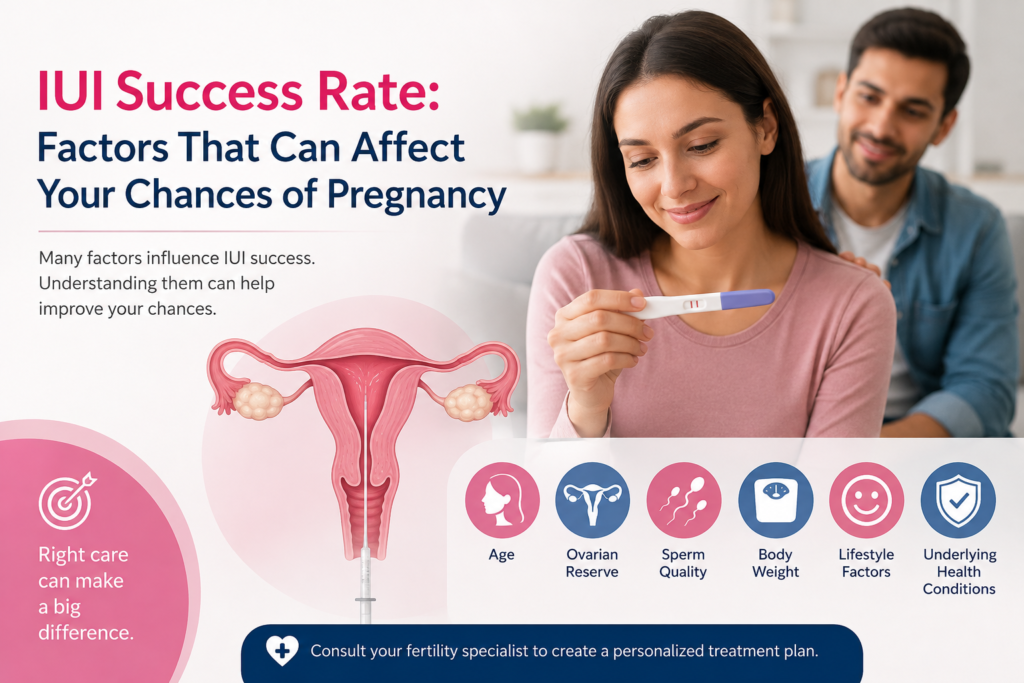
The IUI Success Rate depends on factors such as age, ovulation, sperm quality, fertility diagnosis, and the treatment protocol being used.
What Is the IUI Success Rate?
There is no single success rate that applies to every couple. In general, the chance of pregnancy from one IUI cycle is often in the single-digit to low-teens percentage range, depending on the patient’s circumstances and the clinic’s patient population.
Younger women with healthy ovarian function and good sperm quality may have better chances than those with multiple fertility challenges.
It is important to understand that one unsuccessful IUI cycle does not mean that pregnancy is impossible. Your fertility specialist may review the response to treatment and recommend whether another cycle or a different treatment would be more appropriate.
Age and Egg Quality
Age is one of the most important factors affecting fertility.
As a woman gets older, egg quantity and egg quality gradually decline, which can reduce the chance of conception through IUI.
For this reason, the IUI Success Rate is generally more favorable in younger women, particularly when there are no significant fertility problems.
Your doctor may consider your age, ovarian reserve, previous treatment history, and other factors when discussing your individual chances.
Ovulation and Timing
Successful IUI depends heavily on timing.
The procedure is usually scheduled close to ovulation so that healthy sperm are available when an egg is released. Ovulation may be tracked using ultrasound scans, hormone tests, or ovulation medications depending on the treatment plan.
Accurate timing gives sperm the best opportunity to meet the egg.
This is why monitoring during an IUI cycle can be an important part of improving the IUI Success Rate.
Sperm Quality
Sperm health also plays an important role.
Doctors may assess sperm count, movement, and shape before recommending IUI. During the procedure, the semen sample is processed to concentrate the healthier, more motile sperm.
If sperm quality is significantly reduced, IUI may not provide the desired chances of pregnancy, and your fertility specialist may discuss other treatment options.
Fertility Diagnosis
The reason for infertility can influence the IUI Success Rate.
IUI may be considered for conditions such as unexplained infertility, mild male-factor infertility, ovulation problems, or certain cervical factors.
However, IUI may be less suitable when there are severe problems with sperm production, significant blockage of the fallopian tubes, or other conditions requiring different fertility treatment.
Your doctor will assess the underlying cause before recommending IUI.
Number of Mature Eggs
For some patients, fertility medicines may be used to encourage the development of one or more mature follicles.
The aim is to improve the opportunity for fertilization while avoiding excessive stimulation.
Your fertility specialist will monitor follicle development through ultrasound and may adjust medicines based on your response.
More eggs do not always mean better treatment. Producing too many follicles can increase the risk of multiple pregnancy, so careful monitoring is important.
Fallopian Tube Health
At least one fallopian tube generally needs to be open for IUI to have a reasonable chance of success because fertilization normally occurs inside the fallopian tube.
If both tubes are blocked, IUI is generally not an effective treatment option.
Your doctor may recommend tests to assess whether your fallopian tubes are open before starting treatment.
Lifestyle and Overall Health
General health can also influence fertility.
Maintaining a healthy weight, eating a balanced diet, staying physically active, avoiding smoking, limiting alcohol, and managing stress can support overall reproductive health.
These habits cannot guarantee pregnancy, but they can contribute to a healthier environment for conception.
Following your doctor’s advice about prenatal vitamins, especially folic acid, is also important when planning pregnancy.
How Many IUI Cycles May Be Needed?
Some couples conceive during their first IUI cycle, while others may need more than one attempt.
If an IUI cycle is unsuccessful, your fertility specialist may review ovulation response, follicle development, sperm parameters, timing, and the underlying fertility diagnosis before deciding what to do next.
Depending on your age and individual circumstances, your doctor may recommend trying additional IUI cycles or considering another fertility treatment.
When Should You Consider Other Fertility Treatments?
IUI is not suitable for every fertility situation.
If several well-timed IUI cycles are unsuccessful, or if there are factors that significantly reduce the likelihood of success, your fertility specialist may discuss options such as IVF or other assisted reproductive treatments.
The decision depends on your age, fertility history, test results, previous treatment response, and personal preferences.
Final Thoughts
The IUI Success Rate is influenced by many factors rather than one single condition. Age, egg quality, ovulation, sperm health, fallopian tube function, fertility diagnosis, and treatment timing can all affect the chances of pregnancy.
IUI can be a suitable and less invasive fertility treatment for selected couples, but success cannot be guaranteed with any single cycle.
If you are considering IUI, speaking with a fertility specialist can help you understand your personal chances of success and choose a treatment plan suited to your individual needs.
Every fertility journey is different. The right treatment begins with understanding your individual situation.